
Previous Post: What Is Agentic AI? Understanding the Future of Autonomous Intelligence
As artificial intelligence (AI) rapidly transforms industries worldwide, a new and often overlooked challenge is emerging: massive energy consumption.
Training and operating large-scale AI models require high-performance computing power, which in turn demands tremendous amounts of electricity. Data centers—where AI truly comes to life—are becoming energy-intensive hubs comparable to small cities.
❝ A single hyperscale AI data center can consume as much electricity in a day as thousands of households. ❞
This rising demand prompts some fundamental questions:
- ❓ How can we power AI growth while improving energy efficiency?
- ❓ Can renewable energy alone meet the scale and stability required?
Enter an unexpected contender in the race for sustainable energy: the Small Modular Reactor (SMR).
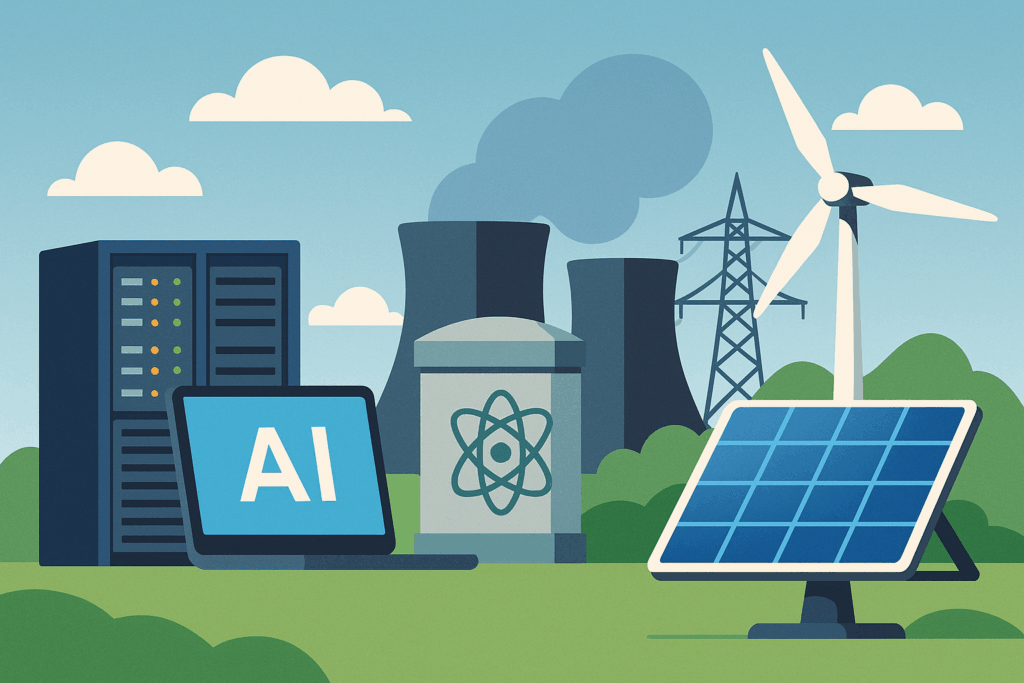
More flexible and inherently safer than traditional nuclear power plants, SMRs are now being explored as a reliable and scalable energy source—especially suited for the energy-hungry AI infrastructure.
This blog explores how SMRs could revolutionize digital energy infrastructure, diving into their technology, synergy with AI, global adoption, and potential to reshape the energy paradigm. 🚀
🔌🧠 Exploding Energy Demands of AI and Data Centers
The more powerful AI becomes, the more energy it consumes—and that growth is exponential. Training a single deep learning model can use the same amount of energy as a car does in its entire lifetime.
AI systems like ChatGPT rely on thousands of GPUs running simultaneously, pushing global electricity consumption to new extremes. And at the center of this storm? Data centers.
📊 Data Center Power Consumption: A Global Snapshot
- 🌍 As of 2023, data centers account for about 3% of global electricity use
- 🔺 Projected to rise to over 8% by 2030, driven by AI workloads
- 🏭 Large centers consume 100–500 GWh annually, depending on scale
❝ Google has openly stated that its AI services are increasing energy use, prompting a search for alternative energy sources. ❞
🚨 Pressure on Global Energy Infrastructure
This isn’t just a cost issue—it’s a systemic one. Increased electricity demand is straining power grids, increasing carbon emissions, and destabilizing supply chains.
While solar and wind offer great promise, their intermittent nature means they struggle to meet the 24/7 reliability needs of modern data centers.
✨ And this is where the Small Modular Reactor (SMR) steps in
SMRs provide constant, weather-independent electricity that’s perfect for mission-critical systems like data centers.
They also offer right-sized scalability, supplying customizable power solutions that align with specific data center needs—something traditional power plants simply can’t do.
💡⚙️ Technological Solutions for Energy Efficiency
With AI and data centers driving up global electricity demand, tech giants and governments alike are racing to improve energy efficiency. It’s not just about saving on electricity bills—this is now a key pillar for carbon neutrality, grid stability, and sustainable digital infrastructure.
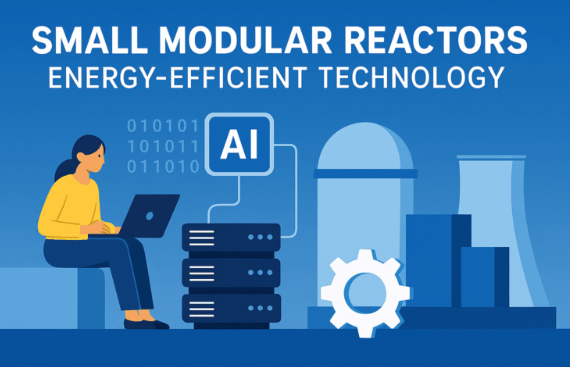
🔬 High-Performance, Low-Power Chips
AI’s brain—its processors—are becoming more energy-conscious. Leading companies are redesigning chips to balance speed and efficiency.
- 📉 NVIDIA’s latest GPUs deliver double the performance-per-watt compared to previous generations
- 🧠 Google’s TPUv5 is optimized for AI workloads while significantly reducing energy use
❝ In AI chip design, performance per watt is now as important as raw speed. ❞
❄️ Advanced Cooling Technologies
Cooling systems account for nearly half of a data center’s energy use. That’s why innovation in this area is critical.
- 💧 Immersion cooling: Submerging servers in special fluids to absorb heat directly
- 🌬️ Natural cooling: Leveraging colder climates to cool facilities without active systems
- 🌱 Heat recovery: Reusing waste heat for nearby buildings or industrial processes
🌍 Global Standards and Energy Regulations
Energy efficiency is now being codified through global benchmarks and local laws.
- 🇪🇺 The EU mandates low PUE (Power Usage Effectiveness) for certified data centers
- 🇺🇸 The U.S. DOE has invested over $200 million in low-power AI chip research
💡 And Then Comes the Game-Changer: Small Modular Reactors (SMRs)
Even with all these innovations, AI energy demands will soon outpace what renewables and current infrastructure can handle alone. That’s why SMRs are being considered as the base-load energy solution for AI infrastructure.
With zero carbon emissions, high reliability, and compact installation, SMRs may provide the final piece of the puzzle for truly sustainable, autonomous data centers.
⚛️⏳ The Return of Nuclear – Why Now for SMRs?
Nuclear power once faded from the spotlight due to safety concerns and public opposition. But now, the global energy conversation is shifting—and Small Modular Reactors (SMRs) are at the center of that change.
🧱 The Limitations of Traditional Nuclear Power
Legacy nuclear plants are massive and complex, making them unsuitable for modern, agile energy needs.
- 🚧 Construction costs often exceed billions of dollars
- 📆 Projects can take 5–10 years to complete
- 🏢 Cannot be built near cities or critical infrastructure
- ⚠️ High public resistance and regulatory hurdles
Such constraints make traditional nuclear unsuitable for the rapidly evolving AI and digital infrastructure space.
🚀 SMRs: Compact, Flexible, Revolutionary
SMRs are exactly what they sound like—small, factory-built nuclear reactors that can be assembled onsite.
❝ If conventional reactors are power plants, SMRs are more like energy appliances. ❞
SMRs typically produce between 50 and 300 MW of power and offer modular deployment, allowing them to be scaled as needed.
📦 Key Features of SMRs:
- 🔧 Modular design: Built in factories and shipped to site for faster deployment
- ⏱️ Faster construction: Often ready within 2–3 years
- 🧯 Advanced safety: Passive cooling and automatic shutdown systems
- 🌍 Site flexibility: Ideal for remote locations, industrial zones, or even near urban areas
🏗️ Deployment Flexibility Is the Key
AI infrastructure needs to be close to urban or network hubs—something traditional nuclear can’t accommodate. But SMRs require far less land, produce less waste heat, and can be tailored to fit energy needs precisely.
All of this makes SMRs a perfect match for data center-driven energy demand.
📈🛠️ Advantages and Technological Advancements of SMRs
Small Modular Reactors (SMRs) are more than just downsized nuclear plants. They’re engineered from the ground up to deliver superior safety, flexibility, and long-term cost savings.
🛡️ 1. Safety First – Passive Cooling and Automatic Shutdowns
Public skepticism toward nuclear power is understandable—but SMRs are changing that narrative.
- 🔥 Passive cooling: Uses natural convection—no power needed to prevent overheating
- 🧠 Automatic shutdown: Reactors self-regulate and shut down if temperatures exceed safe limits
- 🧱 Underground design: Increased protection against natural disasters and security threats
❝ The U.S. Nuclear Regulatory Commission calls SMRs “the first reactor design capable of ensuring safety without human intervention.” ❞
📦 2. Scalability – Add As You Grow
Unlike large plants that must be overbuilt for future demand, SMRs can scale incrementally.
- ➕ Modular expansion: Add new reactors only when needed
- 🧩 Tailored deployment: Suitable for small islands, remote areas, or specific industrial zones
This makes SMRs an ideal match for data centers with evolving power needs.
💰 3. Economic Viability – Lower OPEX, Predictable Costs
SMRs may require upfront capital, but their long-term financial case is strong.
- ⚙️ Factory-built modules: Reduce field labor, cost overruns, and construction time
- 🛠️ Simplified maintenance: Fewer moving parts and higher automation
- 📉 Stable electricity rates: Shield operations from fossil fuel price volatility
❝ According to the International Energy Agency, SMRs could deliver electricity at costs competitive with gas and coal by 2035. ❞
SMRs are not just feasible—they’re rapidly becoming financially attractive in a world where energy cost predictability is key.
🤖⚡ The Synergy Between AI Infrastructure and SMRs
Artificial Intelligence is relentless—its data appetite grows non-stop, and so must its power supply. Enter SMRs. Not just an energy solution, but a strategic backbone for the digital era.
🔌 1. Continuous, Reliable Power
Downtime isn’t an option for AI. Models run for hours—or days—without interruption, and power stability is mission-critical.
- ⚡ SMRs offer 24/7 power generation, regardless of weather or grid stability
- 📉 Resilient infrastructure: SMRs maintain uptime even during peak demand or blackouts
❝ The brain of AI needs a heart that never stops beating. ❞
🌐 2. Integration with Distributed Systems
Modern cloud and AI systems are decentralizing. Data centers are no longer limited to large hubs—they’re spreading out.
- 🏝️ SMRs can be deployed in remote or underserved areas
- 🔐 Great for high-security applications like defense, finance, or national infrastructure
- 🔗 Supports microgrid architecture: Independent power networks with built-in resilience
This makes SMRs ideal for next-generation edge data centers and AI facilities in non-urban zones.
🏭 3. Self-Powered Data Centers – A New Paradigm
The dream of a “fully autonomous, self-powered data center” is closer than ever. With SMRs, companies can:
- 🔋 Produce their own electricity on-site
- 💼 Improve energy budgeting and avoid regulatory risks
- 🏢 Scale power to match the demands of hyperscale computing
In short, SMRs aren’t just compatible with AI—they’re becoming essential to it.
🌍🏗️ Global Adoption – Countries and Companies Leading the SMR Charge
Small Modular Reactors (SMRs) are no longer just theory—they’re in motion. Governments, utilities, and tech giants across the world are investing in SMRs as a cornerstone of their future energy strategy.
🇺🇸 United States – Private Sector-Led Commercialization
The U.S. is one of the leaders in SMR development, with multiple companies advancing toward deployment.
- 📍 NuScale Power: First company to receive design approval from the U.S. NRC
- 🏞️ Building a demonstration site at the Idaho National Laboratory, targeting operation by 2029
- 🤝 Collaborations with Microsoft, AWS, and other AI/cloud companies
🇨🇦 Canada – Integrating SMRs with Clean Tech
Canada sees SMRs as a way to electrify remote areas and support carbon-neutral goals.
- 🔬 Ontario Power Generation (OPG) developing the BWRX-300 model
- 📡 Real-world testing with AI-linked microgrid data centers
- ❄️ Leveraging natural cooling in colder regions for energy efficiency
🇫🇷 France – Using SMRs to Reinforce Nuclear Leadership
France, already a nuclear powerhouse, is using SMRs to modernize and decentralize its grid.
- 🏭 EDF’s NUWARD project: A 340 MW SMR model for deployment in the 2030s
- 🌱 SMRs will replace aging reactors and support grid resilience
🇰🇷 South Korea – Strong Technology, Regulatory Catch-Up
Korea has a homegrown SMR design—SMART—developed by the Korea Atomic Energy Research Institute.
- ⚙️ 100 MW output, ideal for urban and industrial zones
- 🌍 Export agreements signed with the Middle East
- 💡 Growing interest from Samsung, Naver, and domestic data center operators
❝ SMRs are no longer niche technology—they’re becoming part of global energy security strategies. ❞
⚠️🔍 Challenges and Risks of SMR Commercialization
As promising as Small Modular Reactors (SMRs) are, the road to commercialization is filled with hurdles. Let’s take a realistic look at what still needs to be addressed.
🔐 1. Public Trust and Technical Proof
While SMRs are theoretically safer, public acceptance depends on trust—and trust is built through data.
- 🔍 More real-world pilot projects and test data are needed
- 📉 The association of nuclear energy with danger remains strong
- 📢 Public communication strategies are essential for community buy-in
❝ Even if it’s safe on paper, if people don’t believe it’s safe, it won’t get built. ❞ – Energy Conflict Research Institute
📑 2. Regulation and Standardization Gaps
Most global nuclear regulations are designed for large-scale reactors—not SMRs.
- 📘 New regulatory frameworks for modular and scalable designs are needed
- 🌐 No international consensus on licensing procedures
- 🕰️ Lengthy permit processes can reduce investor confidence
Efforts are underway, especially by the IAEA and regional nuclear authorities, to streamline SMR approvals.
🧪 3. Waste Management and Supply Chain Risks
SMRs still generate radioactive waste—though less than traditional reactors.
- 🚛 Safe waste storage and transport solutions remain underdeveloped
- ⛓️ Fuel supply chains are limited to a few countries
- 🤝 A robust system for technology licensing and international cooperation is essential
Additionally, key components are produced by a small group of vendors, creating potential geopolitical dependencies.
These challenges are not insurmountable, but they require collaboration, transparency, and clear policy direction to ensure SMRs reach their full potential.
🌞🌬️💠 Comparing SMRs with Other Alternative Energy Sources
Small Modular Reactors (SMRs) aren’t meant to replace all other energy sources—but they may be the missing piece in a balanced, scalable energy mix.
☀️ Solar & Wind vs. SMRs
Solar and wind are the cornerstones of renewable energy, but they face key limitations:
- 🌤️ Intermittency: Output depends on weather and time of day
- 🏗️ Land-intensive: Requires large areas for utility-scale deployment
- 🔋 Storage constraints: Battery tech is still catching up in cost and capacity
SMRs, on the other hand, offer:
- 🕰️ 24/7 base-load power without interruptions
- 📦 Compact footprint: Ideal for space-constrained industrial zones
- 🔄 Grid synergy: Perfect for balancing intermittent renewable inputs
❝ SMRs don’t compete with solar or wind—they stabilize them. ❞
🔵 Hydrogen Energy + SMRs
Hydrogen, especially “green hydrogen,” is another rising star. SMRs can power electrolysis systems or provide high-temperature steam for hydrogen production.
- ⚗️ Supports high-temperature electrolysis for maximum efficiency
- 🔋 Creates synergy between AI infrastructure and hydrogen storage systems
Excess electricity from SMRs can be used for hydrogen generation, creating a flexible energy loop between data and storage.
🌫️ SMRs and Carbon Capture (CCUS)
SMRs don’t produce CO₂—but they can power carbon capture facilities that clean up existing emissions.
- 🏭 Provide energy to decarbonize steel, cement, and chemical plants
- 🔁 Reduce the carbon footprint of CCUS operations themselves
In essence, SMRs work best not in isolation but in coordination—as the reliable backbone to a multi-source energy strategy.
🌐🚀 Future Outlook – A New Energy Paradigm for the AI Age
AI and energy are becoming inseparable. One can’t scale without the other.
🧠 AI + ⚡ Energy = Strategic Convergence
The future of AI won’t be decided solely by algorithms or chips—it will be determined by who can power them.
- 🇺🇸 The U.S. is linking AI chip production with SMR development under national policy
- 🇨🇳 China is building energy-independent AI zones for cloud and defense applications
- 🇪🇺 Europe is embedding carbon neutrality into AI infrastructure regulations
❝ The AI race may become an energy race: energy sovereigns vs. energy dependents. ❞ – Global Strategy Forum
📡 Energy as a Pillar of Digital Security
Without reliable energy, everything from AI to cloud services to financial transactions can grind to a halt.
In this new world, energy security equals digital security.
- 🛡️ SMRs provide hardened, self-contained systems resistant to grid outages and cyberattacks
- 🏗️ Enable AI infrastructure to exist in geopolitically stable microgrids
♻️ Sustainable AI Requires Sustainable Energy
If AI is to be the brain of the future, SMRs might just be the heart.
- 🔥 Emission-free nuclear power
- 📈 Scalable to match rising data demands
- 🧩 Seamless with other green solutions like solar, hydrogen, and CCUS
❓ Final question: How far can Small Modular Reactors take us as we build the digital civilization of the 21st century?
🎯🌱 Conclusion – Are SMRs the Future of Energy?
Small Modular Reactors (SMRs) are more than a trending energy topic—they represent a fundamental shift in how we power the AI-driven world.
📌 Key takeaways:
- ⚙️ AI data centers demand high-output, always-on electricity
- 🌍 Renewable energy alone may not suffice at hyperscale levels
- ⚡ SMRs offer safety, scalability, and stability unmatched by traditional plants
- 🔄 SMRs integrate well with solar, wind, hydrogen, and carbon capture
❝ AI is the brain. SMR is the heart. Together, they power the digital age. ❞
🚀 What lies ahead?
To fully realize SMRs as a sustainable solution, we need:
- 🧪 More pilot deployments and real-world performance data
- 📘 Flexible global regulatory frameworks
- 🗣️ Clear and consistent public engagement to build trust
Ultimately, SMRs may be the linchpin for sustainable, intelligent infrastructure in the 21st century.
🌟 So, are SMRs the future of energy?
Absolutely—if we choose to make them so.
🇺🇸💹 Why These U.S. Stocks Are Leading the SMR Revolution
As the world accelerates toward AI-driven economies and carbon-neutral infrastructure, the demand for reliable, scalable, and clean energy solutions is rapidly growing. This is where Small Modular Reactors (SMRs) enter the spotlight—not just as a technological solution, but as an emerging investment frontier.
📈 Why focus on U.S. SMR stocks?
- 🇺🇸 U.S. policy leadership: The U.S. Department of Energy (DOE) is investing heavily in next-gen nuclear, especially SMRs, under clean tech and national security mandates.
- 🔧 First-mover advantage: American companies like NuScale have secured regulatory approval ahead of global peers.
- 📡 AI and defense integration: U.S.-based SMRs are being linked with cloud giants (e.g., Microsoft, AWS) and national defense energy grids.
- 📊 Market expansion potential: Many U.S. SMR developers are exploring licensing deals with Europe, Asia, and the Middle East—signaling long-term growth across continents.
These are not speculative penny stocks. These are established, strategically positioned firms with real IP, contracts, and government support.
1. NuScale Power (NYSE: SMR)
- 🏆 First and only company to receive U.S. NRC design certification for an SMR reactor
- 📦 Modular 77 MW reactor units designed for scalable deployment
- 🏗️ Projected grid integration by 2029 at Idaho National Laboratory
- 🤝 Strategic partnerships with data center providers and utility companies
❝ NuScale isn’t just a nuclear company—it’s pioneering decentralized, smart-grid-ready energy. ❞
2. BWX Technologies (NYSE: BWXT)
- ⚛️ Specialized in nuclear fuel and advanced reactor components
- 🚢 Exclusive supplier of reactors for U.S. Navy nuclear submarines
- 📦 Actively developing SMR-class modular fuel systems for commercial and defense use
- 💰 Consistent revenue growth with low exposure to commodity cycles
3. Fluor Corporation (NYSE: FLR)
- 🏗️ One of the largest engineering, procurement, and construction (EPC) firms in the U.S.
- 🌐 Majority shareholder of NuScale Power, giving it direct exposure to SMR growth
- 💼 EPC experience in nuclear, hydrogen, and energy transition infrastructure
📌 Summary – What Makes These Stocks Stand Out?
- 📐 Real-world SMR designs, patents, and government-approved roadmaps
- 🔗 Deep integration with high-demand sectors like AI infrastructure and defense
- 🌍 Export potential to global energy markets in Europe, Asia, and the Middle East
These stocks represent the **intersection of energy security, technological innovation, and global decarbonization strategy**—a rare and powerful combination in today’s market.
❝ SMRs aren’t just about electricity—they’re about power in every sense of the word. ❞
💡 Disclaimer: This content is for informational purposes only and does not constitute financial or investment advice. Final investment decisions are the sole responsibility of the investor.
- 🌐 NuScale Power – Official Website
https://www.nuscalepower.com/ - 🇰🇷 Doosan Enerbility – Official Site
https://www.doosanenerbility.com/en/ - 🌍 IAEA – SMR Policy and Global Framework
https://www.iaea.org/topics/small-modular-reactors